Showing posts with label greenhouse gas reduction. Show all posts

Saturday, May 18, 2013

Destroy The Forest Products Industry And You Help Destroy The Environment

I've been working way too many hours trying to fend off a serious threat to the environment in my own local area.  That led to my being late on this blog.

The threat is called the Lake Whatcom Reconveyance.

Without boring you about local issues, the Reconveyance has world-wide implications.

Ignoring forest health leads to this as illustrated by an 1800s burned off area


In our area, an effort by the pop-environmental movement has been pursued vigorously for several years to convert nearly 9,000 acres of land dedicated to the timber industry into a park. 

The land was dedicated to the timber industry because of a realization by Washington State legislators that an unhealthy timber industry means an unhealthy environment.

This blog has addressed the issue previously.  Consider:

  1. A huge portion of the greenhouse gas emissions released to our atmosphere each year come as the result of forest fires. 
  2. Studies estimate 25% or more of the mercury released to the atmosphere each year comes as the result of forest fires.http://www.sciencedaily.com/releases/2007/01/070109172159.htm
  3. Out of control forest fires boil out streams killing fish populations, burn habitat used by endangered species and otherwise cause environmental havoc.
  4. And so on...


In the United States particularly, the forest products industry has been devastated by the actions of the pop-environmental movement in recent decades.  As a result, so has the environment.  That is why my own little fight against the Reconveyance in my own local area is a fight to help preserve our environment.

A healthy forest products industry is required to maintain a healthy forest.  If we kill the industry, we help kill the forests.

Too often our reactions to environmental issues are based on emotions rather than science; "Ummm, park good, cut tree bad."  

If this blog does anything at all I hope it helps readers to realize that the discussion of issues about environmental impacts generally involve more complexity than the pop-environmental movements want brought up.  All too often, the real purpose of the discussion is the raising of money rather than the solving of issues and full discussion confuses the donors. 

Friday, February 15, 2013

An Easy And Profitable Way To Reduce Greenhouse Gasses

The article following appeared in one of the world's major forest products industry magazines last year.  Headquartered in India, Wood News serves an area containing about half the world's population.  It was an honor to have them publish one of my articles.
Thin kerf sawmilling has been addressed on this blog before but, it is worth addressing again because using a thinner sawblade to mill lumber from a log can lead to 30% more lumber out of a log meaning 30% more carbon is locked up for decades, or even centuries.
Thin kerf sawmilling is also one of the world's best examples of how a very simple technology, mostly operated by everyday working people, can make a huge environmental difference, support sustainability, and enhance local economies.
Anyone purchasing lumber not sawn on a thin kerf sawmill, if the thin kerf is available ( most commonly search for portable sawmills) is contributing to encreased carbon releases to the atmosphere.
Very thin kerf means more lumber and that means less harvest
And so, the article:
THIN KERF SAWMILLING CAN DRIVE ECONOMIC AND ENVIRONMENTAL ENHANCEMENTS
Growing awareness of the important part a strong forest products industry plays in assuring individuals, companies, communities and nations can achieve healthy forest, climate change and economic goals has begun to impact policy decisions by local, regional and national governments around the world.  In India, the importance of the industry in achieving environmental and economic goals comes because growing and healthy forests scrub carbon from the atmosphere and sequester it (store carbon in isolation) until the wood deteriorates.  When trees are converted to lumber, the carbon remains sequestered, often for decades or even for hundreds of years.  Also important, recent advances in processing technology have brought huge improvements in the amount of lumber recovered from the resource as well as dramatically reduced equipment costs.  More recovery and reduced equipment cost is key to the growth of the industry both in terms of competitiveness and, in terms of entry costs, especially in disadvantaged areas. 
Carbon Sequestration
The growing awareness of the part the forest products industry can play in environmental enhancement was highlighted recently (2011) when U. S. Agriculture Secretary Tom Vilsack announced his agency would begin to promote wood “…as a primary building material in green building.” 
The basis of Vilsack’s decision was a U. S. Forest Service Study, Science Supporting the Economic and Environmental Benefits of Using Wood and Wood Products in Green Building Construction.  The study includes an extensive review of the scientific literature on wood as a construction material.  The review led to a conclusion that using wood in building products yields fewer greenhouse gases than the use of other common building materials does.  “This study confirms what many environmental scientists have been saying for years,” Vilsack said.  “Wood should be a major component of American building and energy design.”
From the perspective of a researcher producing the study, David Cleaves, U.S. Forest Service Climate Change Advisor said, “The argument that somehow non-wood construction materials are ultimately better for carbon emissions than wood products is not supported by our research.  Trees removed in an environmentally responsible way allow forests to continue to sequester carbon through new forest growth.  Wood products continue to benefit the environment by storing carbon long after the building has been constructed.”
India’s  Potential For Increasing Carbon Sequestration
The carbon sequestration potential of a healthy forest is considerable and the findings of U.S. studies are as relevant to India as they are elsewhere.  Addressing just one sector of the forest landscape, a 2007 United Nations analysis of India’s forests commented, “Policies that promote agroforestry will help to increase the carbon density of sites relative to traditional agriculture, thereby providing climate change mitigation benefits. Carbon sequestration in Indian agroforests varies from 19.56 tonnes of carbon/hectare/year in Uttar Pradesh to a carbon pool of 23.46 to 47.36 tonnes carbon/hectare/year above- and belowground in the tree-bearing arid agro-ecosystems of Rajasthan. The average sequestration potential in agroforestry has been estimated to be 25 tonnes carbon/hectare/year over 96 million hectares of land in India.”
Agroforestry can be defined as being everything from plantation forests to approaches designed to grow trees and other crops simultaneously on the same land with the two interspersed.  A healthy forest products industry is required to realize, and even enhance, sequestration through agroforestry.   If trees are grown as a crop, a market for the crop must exist to assure an incentive for the growing of the crop.  The highest and best use for logs, as well as the most profitable, is processing of the fiber into salable products.  Nevertheless,  much of the wood  harvested in India is underutilized.  The United Nations analysis estimates 85% of the  roundwood grown in India is consumed as fuel.  At the same time the analysis points to a supply shortage in the country, a clear indication that considerable room for industry growth exists in the nation. 
New Technologies Reduce Costs, Reduce The Need For Imports And Increase Carbon Sequestration
New technologies have greatly improved the ability of the Indian forest product industry to seize the opportunity a supply shortage represents.  In particular, the rise of thin kerf band sawmills as an important part of the industry creates opportunity across the broad spectrum of the industry.
Kerf is the thickness of the cut a blade makes when processing a log.  A comparatively  thick blade like that utilized in conventional sawmills can operate at speed but, considerably more log is turned into sawdust compared to the thin kerf band mill.  Improvements in blade technology by the manufacturers of thin kerf sawmills have allowed for mills capable of industrial levels of production even as yield from a set amount of fiber is increased by as much as 30% when compared to traditional technologies.
First introduced to the broader marketplace by Wood-Mizer Products, Incorporated of Indianapolis, Indiana nearly thirty years ago, the thin kerf portable sawmill and, more recently, industrial versions of the mill have revolutionized the industry.  Today, according to Wood-Mizer, more than 50,000 of their mills are in operation world-wide as are thousands of additional mills manufactured by companies competing with Wood-Mizer.
The efficiency and environmental benefits thin-kerf sawmilling provide was pointed to in a U.S. Forest Service study some years ago.  According to the author, “The US annual cut of timber for lumber products is equivalent to approximately 240 million trees. However, if our sawmills operated at a 70% recovery efficiency, we could get our annual harvest of lumber from 171 million trees. Thus, we could save the equivalent of 69 million trees annually if our recovery efficiency improved from 50% to 70% in our primary processing industry. In addition, these same 69 million trees, if permitted to grow in the forest, would continue to absorb about 900,000 tons of carbon dioxide and produce about 650,000 tons of oxygen each year.”
Increasing use of thin kerf technology will positively impact the Indian forest products industry in four significant ways.  They include:
Environmental Enhancements Through Increased Carbon Sequestration
A 2002 article in the Forest Products Journal, a science oriented publication, cited studies on Russian sawmills concluding, “Through milling improvements that increase the sawmill lumber recovery from 68.3 to 80.0 percent the conversion of carbon from the tree to marketable lumber can increase from 38.9 to approximately 45.6 percent.”  More wood converted to lumber means more carbon continues to be stored in the wood.
Enhanced Use Of The National Resource
Thin kerf sawmills like those produced by Wood-Mizer not only provide substantial yield increases from an existing resource, they allow the use of tree parts and other materials that cannot be efficiently sawn by conventional technologies.  At a recent conference focusing on urban forestry this attribute was strikingly demonstrated when a tree branch only a meter or so in length was stumbled across by a spectator in the nearby brush then milled on a Wood-Mizer to produce strikingly beautiful wood suitable for use as furniture or art wood. 
Thin kerf sawmilling allows wood currently considered to be usable only for fuel wood by conventional mills to be converted into valuable lumber when processed on a band saw mill.
Greater Yield From Log Imports Means More Profit Per Log And Less Need To Purchase
The positive implications on the need to import wood to fill India’s appetite for wood products are obvious if yield from a given resource can be increased by 20 – 30%.  Profit per log for the processor increases even as the outflow of capital from the nation is reduced.
Enhanced Access To The Industry Due To Increased Profitability And Reduced Costs
Small thin kerf sawmills can be purchased for a fraction the cost of conventional sawmills.  Studies done at Auburn University in the United States point to the ability the mills provide to cooperative ventures, small scale enterprises and others to enter the marketplace.  A significant majority of the 50,000 mills Wood-Mizer has sold over the years have resulted in the formation of thousands of family businesses. 
Conclusions:
Population increases leading to supply shortages, a significant opportunity to make use of currently underutilized fiber to produce high quality products and the opportunities afforded by new technologies lead to the inescapable conclusion that the Indian forest products industry is on the cusp of substantial growth.  The beneficiaries will include industry participants as well as the people of the nation as a whole.
Optimizing yield from the resource is especially important in countries like India where the resource is limited compared to demand.  Because thin kerf sawmills are capable of significantly increasing yield from a log they represent one of the most important innovations seen by the industry in recent years.


Sunday, November 4, 2012

Coal May Be Our Most Important Future Energy Source

It’s interesting to watch the pop-environmental industry flail about regarding the issue of energy derived from coal.  Coal, according to the pop-enviros, is the big, bad devil monster hiding under the bed, waiting to leap out and devour us all with greenhouse gasses, sooty pollution and other noxious emissions likely to lead to the end of society as we know it.


Once America's Transportation Network Was Coal Powered.  Perhaps In The Future Coal Will Power The World's Industry
It’s equally interesting to watch the more or less ineffectual responses the coal industry mounts to the foamy mouthed invective hurled at it by the pop-enviro community.  If corporations were as powerful and skillful as they are reputed to be by the 99 percent crowd, one would think an industry like that centered on coal would do a better job of messaging.
In fact, regardless of the vociferous braying of the one side and the meek, “I’d better pull my head back in the shell” responses of the coal industry, coal may have the potential to bring about massive reductions in greenhouse gas emissions along with many other social benefits.
Here’s some of what the U.S. Department of Energy has to say about its investigations into the coal issue:  “Hydrogen from coal research supports goals of increasing energy security, reducing environmental impact of energy use, promoting economic development, and encouraging scientific discovery and innovation by researching and developing novel technologies that convert the nation’s abundant coal resources into hydrogen. The use of coal — America’s largest domestic fossil energy resource — offers the potential to economically produce hydrogen and capture carbon dioxide emissions for the generation of low-carbon electricity.”
As has been pointed out in an earlier blog on this site, using hydrogen to power America’s vehicle fleet has been a dream for decades.  The primary emission from burning in an engine is good old water.  If the claim that much of the man made pollution leading to global warming… er… I mean climate change, and other damaging impacts is due to excess emissions from automobiles then, much of that pollution could be removed if we switch over to hydrogen as a primary power source.
Until now that’s been difficult because it takes too much energy to produce hydrogen but, again, from the Department of energy, “Hydrogen can be produced from coal by gasification (i.e., partial oxidation).  Coal gasification works by first reacting coal with oxygen and steam under high pressures and temperatures to form synthesis gas, a mixture consisting primarily of carbon monoxide and hydrogen.  The synthesis gas is cleaned of impurities and the carbon monoxide in the gas mixture is reacted with steam via the water-gas shift reaction to produce additional hydrogen and carbon dioxide.  Hydrogen is removed by a separation system and the highly concentrated CO2 stream can subsequently be captured and sequestered.  The hydrogen can be used in a combustion turbine or solid oxide fuel cell to produce power, or utilized as a fuel or chemical feedstock.”
Further, “Gasification of coal is a promising technology for the co-production of electric power and hydrogen from integrated gasification combined-cycle (IGCC) technology.  However, there currently are no commercial demonstrations of these joint power and hydrogen plants.  Conceptual plants have been simulated using computer models to estimate technical and economic performance of co-production facilities.”
Clean coal technologies based on producing hydrogen and other valuable materials from raw coal and then using the char, or remaining byproduct in materials like aggregates for making bricks or other useful materials may well be the wave of the future. 
Because coal may have the potential to so dramatically reduce climate change gasses and other emissions to the atmosphere one can only wonder at the knee jerk responses to the shipping and use of coal so evident today.  Surely something with so much potential for cleaning up the earth's evironment deserves serious consideration?

Sunday, September 16, 2012

Wasting Urban Wood = Increased Greenhouse Gas Emissions

Following is an article that appeared in a great little progressive forest products industry magazine:  Timber/West.
While the article is about a conference in San Francisco about using wood harvested from city forests, the application is world wide.  Even in wood rich nations it makes sense to utilize urban wood for lumber.  Each million board foot or cubic meter of lumber recovered from urban "waste" represents fiber not requiring harvest in healthy forests.  In wood poor nations, even those where fuel wood is important, every piece of wood recovered represents a piece that does not have to be imported or done without.
Anyway, here is something to consider:

From This
To this... everything is made from reclaimed urban lumber

New Approaches Mean New Opportunities
By Jack Petree
Groundbreaking work by David MacFarlane of Michigan State University’s Department of Forestry should cause those interested in the shape of the nation’s future forest products industry to sit up and take notice.
Billions of Board Feet
Recent work by Dr. MacFarlane indicates the U.S. urban forests are capable of producing annually about 3.8 billion board feet of wood suitable for processing into building products on a sustained basis through efficient removal and processing of dead and dying trees. On an annual basis, MacFarlane calculates, that is the board foot equivalent of the material required to build about 285,000 homes. All that from a resource that all too often has been considered waste to be disposed of in landfills.
In recent years, MacFarlane and other research professionals have participated in a number of efforts aimed at building awareness of, and making better use of, the resource represented by urban forests. The efforts have resulted in a fledgling urban forest products industry with considerable potential to become an important sector of the larger timber industry.
California Urban Forest Products Conference
A The 2011 California Urban Forest Products Conference (a gathering of industry participants in San Francisco) represented one more step in demonstrating the premise that urban forestry is a growth industry sector capable of one day changing the business landscape for harvesters, processors, lumber merchandisers, and end users of lumber and other wood products.
In the first half of the 20th Century, economist Joseph Schumpeter pointed out that while change created by entrepreneurial innovation creates economic growth, it can also lead to the destruction of older businesses, occupations, and approaches to business based on newly outmoded technologies or market conditions; firms not keeping up with the pace of change eventually perish.
Growth Industry
Few industries have seen as much change in recent decades as has the forest products industry. Some sectors of the industry were decimated by the winds of that change, but new industry sectors have seen considerable growth over those same decades. The California Urban Forest Products Conference opened a window offering a view of a forest products industry that may be on the edge of a significant growth spurt.
The ground breaking conference had loggers, academicians, sawmill owners, craftsmen and women, contractors, representatives from state and local governments, and avid members of green activist groups all rubbing shoulders as they explored the potential for working together to promote the vitality, diversity, and health of the urban forest across California. Sponsors of the event included the California Urban Forests Council, the California Department of Forestry and Fire Protection, and San Francisco’s Friends of the Urban Forest, a group dedicated to working with individuals and neighborhoods to plant and care for street trees and sidewalk gardens in San Francisco.
In the past, the concept of urban forestry has mostly been ignored by the traditional forest products industry. The lack of interest is partly based on a realistic appraisal of the difficulties inherent in relying on the urban forest for a dependable supply of fiber but lack of information about the potential the urban forest has in producing fiber to fill the nation’s need plays a part as well.
On the other hand, innovative entrepreneurs, like those attending the California Urban Forest Products Conference have been, in recent years, actively exploring the potential offered by 3.8 billion board feet of available material suitable for conversion to useful product.

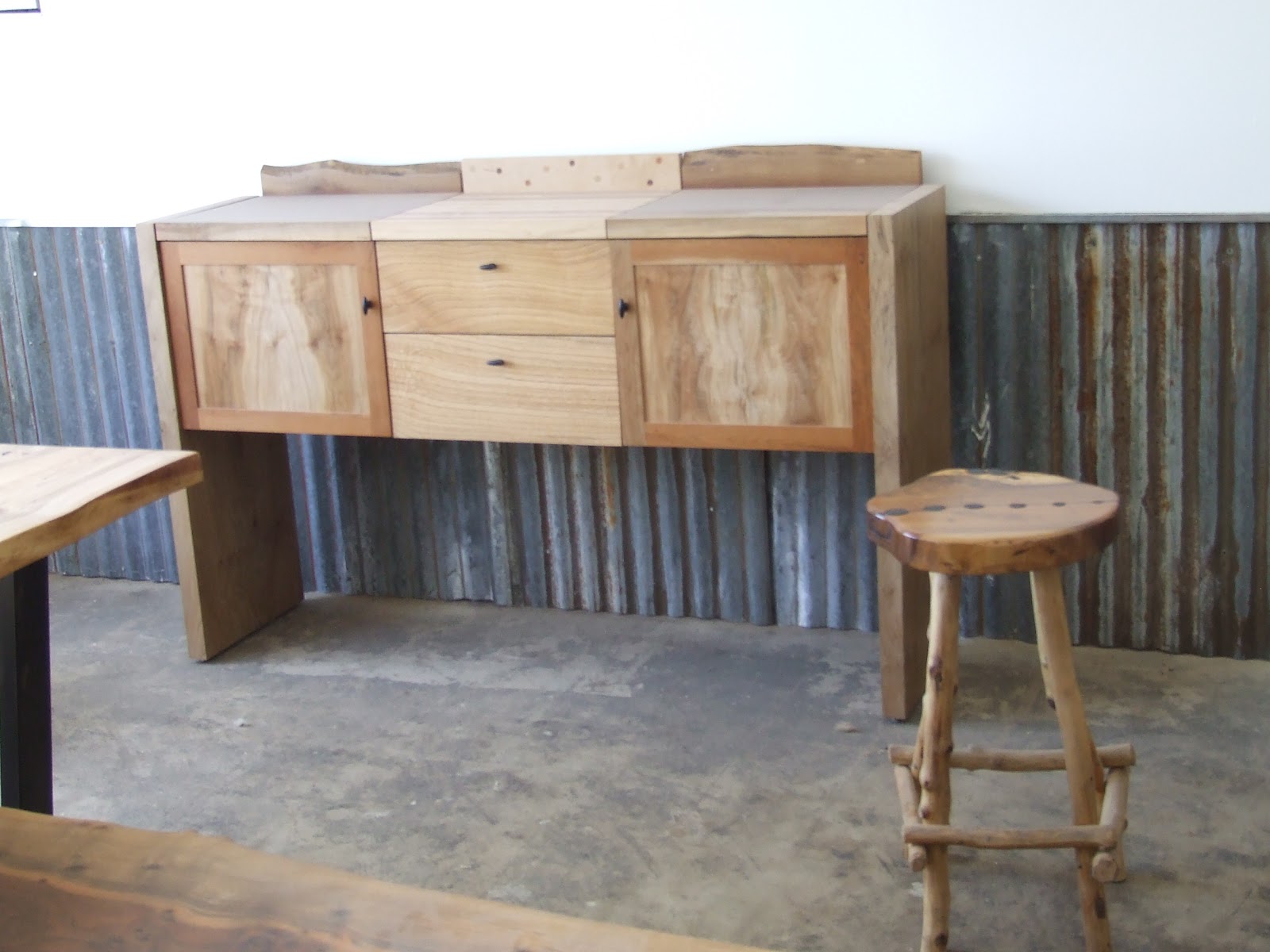
Counter tops made from "waste" wood:  Woods Coffee
Building a Business
It is likely to be some years before a strong national urban forest products industry becomes a fully developed and established sector of the larger and more traditional forest products industry.
The California conference featured plenty of material spotlighting the difficulty firms will face in establishing and building a business based on urban forest products. However, based on information put forward at seminars, panels, and other presentations during the three days of the California Urban Forest Products Conference, there are strong indications that rapid growth and increasing stability for the urban forest industry of the future are not only possible, but likely.
While not everyone’s cup of tea, participants in today’s conventional forest products industry might want to take a close look at where the urban based segment of the industry is going as it builds into a significant supplier of lumbers, especially specialty lumbers, to serve the nation’s future needs.
Change is in the air.

Monday, June 11, 2012

Forest Fires And Greenhouse Gas Emissions - We Fail The Forest When We Oppose All Harvest

One of the ways the pop-environmental movement is most successful at assuring plenty of greenhouse gasses are emitted to the atmosphere is to hinder attempts to treat forests for forest health.  The successes go beyond increased greenhouse gas emissions.  In the United States and Canada, at least, decades of neglect in terms of treating for fire reduction have created a situation where forest wild fires burn so hot they vaporize streams, and everything living in them and, actually smelt things like mercury from the ground, sending it into the airstreams to settle in lakes, streams, bogs and lungs.

Modern forest fires tend to be more intense than most were in historic times
Forest fires are, of course, nothing new in North America.  American Indians routinely burned forests, plains and anything else that could be burned to increase berry yields, attract tasty critters like deer, and other game animals, burn out enemies, create clearings and for a variety of other reasons.  When Isaac Stevens arrived in Washington Territory in 1853 fresh off a triple threat trip on which he surveyed routes for a potential transcontinental railroad, signed treaties with Indian tribes and, on arrival took office as first Governor of the territory one of his first observations was to the effect that the whole region seemed to be on fire.
But wildfires, into the early years of the 20th Century, were generally different from wildfires today because the forest was different.  Today’s forests, especially in the American and Canadian intermountain west, are far more densely populated with trees, than they were when the pioneers first arrived on the scene.  Even more important, the fuel loads at forest floor level and up are immensely greater than they were 100 years ago so fires are much more prone to climb the fuel ladder from forest floor to the crowns of the trees and erupt into conflagrations that leap from tree to trees and are very difficult to suppress.

Isaac Stevens meets with the "Nez Perces" in 1852 or '53.  Note the state of the forest in terms of fuel loads.  The Stevens expedition included an artist charged with accurately rendering a visual record of the trip.

The modern forest is overloaded with fuel stock and too many trees making the forest a prime candidate for catestrophic fire
We know 100 + years of fire suppression is the big reason we have larger and more destructive wildfires.  That is not a reason to ignore the forest in the hopes things will go back to normal if we just bury our heads in the sand, or ashes, long enough.  We have the technology to restore the forests to more historic conditions but, thanks to the pop-environmental movement, we all too often lack the will to accomplish the task; the movement would rather see a fire unnecessarily burn an old growth tree than see a well managed thinning regimen reduce the intensity of a fire to the level where larger trees can withstand the fire event. 
The problem with large wildfires is they not only put the forest at risk, they emit massive amounts of pollutants into the air.  A single wildfire can emit many times the greenhouse gasses, particulates and other pollutants many entire industry sectors emit in entire years.
Dr. Thomas Bonnicksen is one of the world’s leading experts on forests and forest health.  In recent years he has developed a model for assessing the consequences of forest fires called, simply enough, the Forest Carbon and Emissions Model.
In 2009 Bonnicksen published the third in a series of examinations of emissions resulting from forest fires in California titled Impacts of California Wildfires On Climate And Forests:  A Study of Seven Years of Wildfires (2001 – 2007).
On summarizing the findings of his work Bonnicksen said, “The wildfire crisis is becoming more serious each year. Fires are getting bigger, more destructive, and more expensive. In 2001, California wildfires burned one-half million acres. In 2007, 1.1 million acres burned, and an estimated 1.4 million acres burned in 2008 destroying 1,000 homes. This was the most destructive fire season in the state’s history and 2009 could be worse.”
Discussing the emissions resulting from the fires Bonnicksen commented, “From 2001 to 2007, fires burned more than 4 million acres and released an estimated 277 million tons of greenhouse gases into the atmosphere from combustion and the post-fire decay of dead trees. That is an average of 68 tons per acre. These wildfires also kill wildlife, pollute the air and water, and strip soil from hillsides. The greenhouse gases they emit are wiping out much of what is being achieved to reduce emissions from fossil fuels to battle global warming.”
Putting the impacts of fires in context, Bonnicksen pointed out, “The emissions from only the seven years of wildfires documented in this study are equivalent to adding an estimated 50 million more cars onto California’s highways for one year, each spewing tons of greenhouse gases. Stated another way, this means all 14 million cars in California would have to be locked in a garage for three and one-half years to make up for the global warming impact of these wildfires.”
Much of the damage done by unnecessarily intense forest fires in California and, across the rest of the United States and Canada can be reduced by a rational and well managed treatment program aimed at enhancing the health of the North American forests.
Well meaning, but misguided, demands that forests be left to their own devices only result in more destruction of the forest resource, huge amounts of unnecessary pollution and the waste of vast amounts of time and money better spent on ends with more likelihood of success. 

Friday, June 1, 2012

The Environmental Consequences of Planning To Fail

The City of Bellingham as it has to look in just ten more years based on current planning documents.  The Yellow building just visible in the upper right is currently Bellingham's tallest building; a building constructed about 3/4 of a century ago.

                                               ..................

“Whatever failures I have known, whatever errors I have committed, whatever follies I have witnessed in private and public life have been the consequence of action without thought”.

Bernard Baruch, Wall Street mogul and economic advisor to presidents Woodrow Wilson and Harry Truman 

“We must stop talking about the American dream and start listening to the dreams of Americans.”

- Reubin Askew, former Governor of Florida


Almost nothing we do as a society has more impact on the earth’s environment than our efforts to accomplish land use planning. 

Almost nothing we do as a society is more susceptible to the unintended consequences of introducing politics and the emotion based approaches typical of the pop-environmental movement than our efforts to accomplish land use planning. 

Nearly 100 years ago, in the wake of the First World War, three young musicians penned a tune including the words, “How you gonna keep ‘em down on the farm, after they’ve seen Paree?”

The song reflected the fact that, in a modern economy, most people prefer life in the city to life in the country. 

In terms of avoiding environmental degradation and of creating opportunities for environmental enhancements, that preference for city life is a positive thing.  A well planned cityscape with opportunities for citizens to “live the American (or European, or Asian or, whatever) dream” is filled with opportunity to protect and improve the overall environment.

 The problem with most land use planning approaches stems from the fact the approaches are designed and implemented by governments; they are highly susceptible to being interest group driven both during the planning effort and, after.

While Bellingham planned for unprecedented growth in its downtown core the City did not follow its own planning initiatives in the buildings it constructed.  "We couldn't afford to do it," one decision maker told me, demonstrating the perils of unrealistic planning in terms of achieving environmental goals.
An old proverb with some version in most societies has to do with how a donkey can be induced to pull a wagon.  The two choices are the carrot, or the stick.  A carrot hung on a string in front of the donkey will induce the animal to strain forward in an attempt to eat the carrot and, in the process, the cart is pulled forward. 

Alternatively, whipping the donkey with the stick will irritate the animal enough to induce it to attempt to avoid the irritation by moving forward and pulling the cart.

In planning, an equivalent process plays out in most jurisdictions.

At its bottom, at least in most North American areas, the goal of land use planning is to induce as many people as possible to live in and near cities.  More people living in cities means fewer people choosing the rural experience.  The choice to live in a city environment rather than rural is generally seen as a good thing in environmental terms.

A second consideration is that, especially regarding the pop-environmental movement, a strong undercurrent in the discussion is a desire to restrict all growth in a jurisdiction; “If you must go somewhere, go somewhere else!”

Enter the carrot or the stick question. 

As the issue plays out in Whatcom County, the place where I live, and especially in Bellingham, the county seat, the pop-environmental movement not only wants most growth, if it must occur, to take place in the city, the movement wants that growth to be confined to the urban core.

As a consequence, County and City planning approaches rely heavily on the stick; “You will all live in high rise buildings in and near the downtown core or you will not live here at all.” 

The problem the planning approach does not address is that few Americans lie awake at night dreaming about raising their children on the eighteenth floor of a high rise.  In fact, most Americans, of all ages, reject the option. 

What actually occurs on most sites in the downtown core

Faced with a planning approach designed to make city life as miserable and as expensive as possible (and successful in doing that), many Whatcom County residents who would prefer life in the city, find themselves forced to choose a rural lifestyle.

What about the carrot?

Some years ago Whatcom County inadvertently tried the carrot approach to planning as the result of a State law called the Growth Management Act (GMA).

The result of meeting the requirements of the Act was that for a period of about seven years Bellingham had adequate land supplies to support a broad variety of housing choice.  For those seven years, 62% of all the growth in the county came to Bellingham.

But the new people weren’t living in tall buildings.  They were choosing to live in single family homes, albeit on much smaller lots than had been the tradition in the city and in ground saving housing styles (row houses, etc.) also not traditional in the city; exactly the result hoped for when the GMA was passed.

What was actually built on a site assumed to contain two eighteen story towers in City Planning documents.  The towers were actually counted as being completed in the existing plan but market realities created by the lack of desire most have to live in structures like those the city plan envisions required a downsizing.
At the end of seven years, miffed by the fact that people still chose to live and raise their families in Whatcom County a new approach to growth was implemented; the stick.  The ability to capture growth in the single family areas was eliminated.

The result? 

Today only about 20% of the population growth in the County takes place in its chief city.  A plan that relied on the building of dozens of 20 story plus skyscrapers to house residents of the city has not produced even one such building, or anything half as tall.  And people choose the rural lifestyle as a result.

Rather than look at what has happened and once again make the cities places people want to choose, the reaction by the pop enviro movement has been to begin an attempt to eliminate growth in the rural areas as well as in the cities.

The result?

Whatcom County sports the worst economy in Western Washington among the county’s peer counties.  Growth continues but, at the cost of continued “flight to the fields” as citizens run from draconian interference in their lives inside the cities.  Most importantly, all the environmental impacts coming as the result of forcing people who would otherwise choose life in the cities to choose a rural life instead continue to mount up.

Monday, May 28, 2012

WANT TO REDUCE GREENHOUSE EMISSIONS: CONSIDER NOT BUILDING TO LEED STANDARDS

Leadership in Energy and Environmental Design, commonly known as LEED is a set of privately established building standards established by an activist non-profit, the U.S. Green Building Council, to promote “green building” through a system of points theoretically designed to allow a building to be constructed in a way that enhances the environment.
As a way to promote elitism in the environmental world, LEED works well.  It costs architects, contractors, and the manufacturers of “green” products thousands and tens of thousands of greenbacks to become certified for LEED.  Governments and others with the money to pay to achieve a variety of “grades” offered by LEED get to brag about the wonderfulness of their buildings; “Look at me, ordinary people can’t afford this so I’m special.”  And, of course, the cost be damned.
But consider:
One of LEED’s big efforts is the reduction of greenhouse gas emissions to the environment.
The problem is, in many ways, LEED’s standards work to increase greenhouse gas emissions rather than reduce them.
As just one example consider, trees removed from a power line right of way project then milled into lumber using the most environmentally advanced equipment (very thin kerf sawmilling) do not qualify for LEED even if the milling company is willing to go through the huge extra cost needed to qualify as a provider of LEED certified materials then do the chain of custody tracking necessary to qualify for LEED points.
Lumber acceptable to LEED mostly must come from healthy forests, certified as being managed for long term sustainability (exceptions include some salvage or recycled lumbers).
That means lumber created from trees removed as the result of right of way clearing, removal of danger trees and for other, similar uses, cannot be substituted under LEED's system for lumber harvested from healthy forests. 
So, consider the millions of acres of trees killed in the intermountain west by pine beetle, mistletoe and other epidemics.  Lumber milled from the trees is perfectly usable and, absent being utilized for things like construction, will rot or be burned in catastrophic forest fires, emitting thousands and even millions of tons of greenhouse gasses into the atmosphere.  Why shouldn’t lumber from those trees not only be eligible for LEED points regardless of the custody chain?  Where's the LEEDership in that?

A Colorado Home Built Entirely From Beetle Killed Pine Trees - This Would Not Qualify For LEED Points Except Those Available For "Locally" Produced Materials
Well, allowing those kinds of substitutions (lumber milled from dead, but not certified, trees for lumber milled from healthy trees wouldn’t bring in much money, would it?
And all that begs the question regarding LEED’s apparent love affair with concrete, one of the major sources of greenhouse gas emission in the world.
The LEED program was so elitist, and thus so restrictive in excluding many of the greenest green approaches to construction that California took the remarkable step a couple of years ago of establishing its own green building provisions using the California Building Code.  CALGreen, as the new program was dubbed, went into effect in January of 2011.  Many believe CALGreen has made LEED irrelevant in California as a result of its broader approach to green building.
As one pundit, writing for Reed Construction Data put it,   Prior to CALGreen, some forward-thinking building departments seeking to improve energy efficiency and other building performance criteria, had required LEED certification for certain types of buildings. Los Angeles has now taken the step of replacing LEED standards with CALGreen, and has even extended the green building code to include renovations, going beyond the baseline requirements of CALGreen. Many experts and pundits in the green building industry have wondered if USGBC's LEED certification (a third party program) would remain relevant in light of government initiatives. For Los Angeles, the answer is now clear.”
As put forward by Wayne Engebretson, writing for Reed Construction Data, “A key result of the code is that it will allow designers, contractors, and owners to plan and build to a certifiable green standard without having to go through the submittal process, and pay, for third-party certification. The CALGREEN Code mandates required field inspections using a public, transparent infrastructure. The advantage is that one code covers all occupancy types, while various third-party certification systems require a different set of guidelines for each occupancy type covered.  There isn’t a point-based system, standards and regulations replace a measurement system. The regulations were developed by consulting with both the California building industry and environmental groups. Additional provisions were written in case local jurisdictions wanted to adopt even more stringent code. CALGREEN also provides design options that will allow the designer to determine how best to achieve compliance for a given site or building condition.  In other words, the state of California is eliminating the need for third party, proprietary certification standards by establishing a tiered system.”
When the owner of a thin kerf band portable sawmill buys a truck load of firewood and mills it up into very high end lumber for use in remodeling a home, that owner has performed a remarkable service to the community in terms of environmental enhancements. 
All the unpainted wood here was milled from firewood or untreated poles destined to be chipped or burned but, instead, milled into high value but low cost products by Pony Boy Gilbert of Veneta, Oregon.  Pony Boy also did the remodel and, provided the photo.  The lumber cost a fraction the cost had it been purchased through conventional channels and, does not qualify for LEED other than the points available for local production of materials.

LEED might not allow credit for that but the purchasers of goods and services who are interested in actually building green should be.

Wednesday, May 23, 2012

Garbage In - Garbage Generated Greenhouse Gasses Out

Garbage in, garbage out?
Not if you live anywhere near my neck of the woods where, it seems, we are dedicated to shipping our environmental problems elsewhere; at the cost of many tons of greenhouse gas emissions each year.
Garbage disposal has been an issue for mankind for as long as mankind has existed.  Few things make an archeologist lick his or her lips more than the discovery of a new midden with its treasure trove of broken kitchen utensils, shells, bones, and other stuff even the poorest of our ancestors tossed.
When I was young, most “garbage” was disposed of in either private dumps or in the town dump.  My dad, and many others, cheated the archeologists of the future by picking through the local dump for items someone else might have seen fit to throw away but we could use.  “Waste not, want not,” was the rule of the day in our house.
In the modern era nearly everything has become disposable.  I don’t know if that is bad or good but, it is a fact of life.  We, especially in America but, elsewhere as well, create mountains of garbage as we live out our lives.
How we dispose of that garbage says a lot about how we view the environment around us.  Is garbage a resource as it was to my father's generation or, is garbage waste; to be filed away somewhere for the archeologists of the future to ponder over?
In my home town, the pop-environmentalists have had their way so we do all we can to assure our garbage disposal issues are resolved by the “out of sight, out of mind” approach to problem solving;  “Got a problem? Ship it somewhere else and put it in a hole so I don’t have to look at it.”
The problem is, of course, a “Ship it somewhere else and put it in a hole so I don’t have to look at it,” approach results, in our case as least, in tens of tons of unnecessary diesel emissions to the atmosphere, an increase in fossil fuel use as electricity that could have been created through the incineration of non reusable garbage is not produced and, perhaps worst of all, the creation of an attitude that as long as we can ship a problem elsewhere there is no problem. 
In my community, garbage is collected then taken to a central location, compacted, containerized and loaded aboard freight trains for shipment. 
Containers loaded with garbage await shipment; out of sight, out of mind
It is an interesting aside that with few exceptions, manufactured goods cannot be shipped in or out of the community by train but, in order to avoid handling our own garbage we’ve managed to find a way to get the containers onto trains.
The garbage is then shipped across the mountains bordering coastal Washington to one of two destinations a couple of hundred miles out of sight where it is off loaded and dumped into a hole in the ground.
We are so proud of getting our garbage out of sight and out of mind in Whatcom County that we, as part of a report on greenhouse gas emissions in the county done under the auspices of our local Northwest Clean Air Agency and a pop environmental group of governments called ICLEI, proclaim:
“The greenhouse gas emissions generated from waste are dependent on the type of waste being disposed of and the configuration of the landfill where waste is disposed. Two processes usually occur in a landfill. First, the waste does not completely decompose, which causes some of the carbon that would have been released as CO2 to actually be sequestered in the landfill. Second, because of the lack of oxygen in the landfill, the decomposing matter is released as methane, a greenhouse gas 21 times more potent than CO2. If methane is not captured or burned, the landfill is a net source of greenhouse gas emissions. And in these cases, waste disposal can be a significant part of a community’s climate pollution profile. Some solutions include capturing the methane to produce energy or burning it to convert it back to the less potent CO2.”
Whatcom County’s waste is sent to Columbia Ridge and Roosevelt Landfill, sanitary landfills with methane recovery factors between 56% and 80%. This means that the majority of what decomposes in the landfill and is released as methane gas is captured (or “recovered”) at the landfill. In the County’s case, the net result is that a little bit more carbon equivalent is buried and trapped in the landfill than is added to the atmosphere. This effect explains why eCO2 emissions from our waste sector are reported as negative.”

Whatcom County is to be emulated world wide.  Who else can gather garbage, transport it by train for hundreds of miles, throw it into a hole in the ground and END UP WITH NEGATIVE EMISSIONS?
But wait.  We are proud of burning thousands, maybe tens of thousands of gallons of diesel to get our garbage to a place where we can produce methane from it but, happy days, we only emit 20 – 44% of that methane to the atmosphere?
We used to incinerate our garbage in our community, making electricity in the process.  The result?  Sure, carbon is emitted, but not concentrated in the form of methane!  And, fossil fuel emissions resulting from producing electricy using coal or gas fired plants are avoided.
And think about what the pop enviros don’t consider here.  Any strategy for disposal that can be utilized 200 miles away can be utilized in the community.  So where is the consideration of the emissions caused by a 200 mile trip to get the resource out of sight and out of mind?  Or is that kind of like the local city’s being lauded for purchasing 108% of its power from green energy sources?


Sunday, May 20, 2012

Coal As An Environmental Enhancement?

A commenter on this blog recently asked, albeit indirectly, if I thought coal had a future as an energy source.
That is a good question. 
Coal, at present, has a pretty bad reputation.  How much of that is deserved and how much is manufactured is a matter of speculation. 
I think the answer to the question is probably “Yes.”
Despite all the angst about shipping and burning coal the fact remains coal is one of the most abundant energy sources on earth and, in some ways, if we learn to use it properly, one of the least impactive in an environmental sense.  In many of the largest economies coal also has the advantage of being abundant within the borders of the nation, therefore providing at least the possibility of energy independence.
Coal hasn’t always had the reputation it has today.  A 1946 advertisement for Pope and Talbot Lines brags up my hometown’s port in part because the city contains, “…the largest coal mine in the state.” 

Just as coal’s reputation has slipped, coal’s reputation can rebound.
As just one example, consider Germany, projected to be one of the United State’s leading customers for coal in coming years.  Germany is decommissioning nuclear power plants and building dozens of new coal plants to serve the energy needs lost to that decommissioning. 
The key to the future of coal is probably in a process called “gasification.”
According to the U.S. Department of Energy, “Coal gasification offers one of the most versatile and clean ways to convert coal into electricity, hydrogen, and other valuable energy products.”
Addressing the environmental aspects of gasification, the department reports, “The environmental benefits of gasification stem from the capability to achieve extremely low SOx, NOx and particulate emissions from burning coal-derived gases. Sulfur in coal, for example, is converted to hydrogen sulfide and can be captured by processes presently used in the chemical industry. In some methods, the sulfur can be extracted in either a liquid or solid form that can be sold commercially.  In an Integrated Gasification Combined-Cycle (IGCC) plant, the syngas produced is virtually free of fuel-bound nitrogen.  NOx from the gas turbine is limited to thermal NOx. Diluting the syngas allows for NOx emissions as low as 15 parts per million. Selective Catalytic Reduction (SCR) can be used to reach levels comparable to firing with natural gas if required to meet more stringent emission levels. Other advanced emission control processes are being developed that could reduce NOx from hydrogen fired turbines to as low as 2 parts per million.
The Office of Fossil Energy is also exploring advanced syngas cleaning and conditioning processes that are even more effective in eliminating emissions from coal gasifiers. Multi-contaminant control processes are being developed that reduce pollutants to parts-per-billion levels and will be effective in cleaning mercury and other trace metals in addition to other impurities.
Coal gasification may offer a further environmental advantage in addressing concerns over the atmospheric buildup of greenhouse gases, such as carbon dioxide. If oxygen is used in a coal gasifier instead of air, carbon dioxide is emitted as a concentrated gas stream in syngas at high pressure. In this form, it can be captured and sequestered more easily and at lower costs. By contrast, when coal burns or is reacted in air, 79 percent of which is nitrogen, the resulting carbon dioxide is diluted and more costly to separate.”

A coal gasification plant in Tampa, Florida
As study by the United Kingdom’s Parliamentary Office of Science and Technology speculates future emissions from the use of coal (with carbon capture technologies employed) will be about 1/7th what they are today but there is an additional factor needing to be considered.
The Department of Energy discussion regarding coal gasification points out, “Gasification, in fact, may be one of the most flexible technologies to produce clean-burning hydrogen for tomorrow's automobiles and power-generating fuel cells. Hydrogen and other coal gases can also be used to fuel power-generating turbines, or as the chemical "building blocks" for a wide range of commercial products.”
For decades, hydrogen has been considered to be the premier fuel of the future in the nation’s automobiles.  When hydrogen combusts the major product of combustion is water but, hydrogen is difficult to produce in a cost and energy effective manner.
If coal provides the means to shift to a hydrogen economy in lieu of a fossil fuel based economy as the result of gasification, enormous benefits in terms of green house and other gas emissions might be realized.  The carbon footprint of coal might be negative in that use of the hydrogen produced in the gasification process replaces the use of petroleum products.
Does coal have a future?
Almost certainly it does.  In fact, the future of coal might just be bright.