Showing posts with label environmental enhancement. Show all posts

Friday, February 15, 2013

An Easy And Profitable Way To Reduce Greenhouse Gasses

The article following appeared in one of the world's major forest products industry magazines last year.  Headquartered in India, Wood News serves an area containing about half the world's population.  It was an honor to have them publish one of my articles.
Thin kerf sawmilling has been addressed on this blog before but, it is worth addressing again because using a thinner sawblade to mill lumber from a log can lead to 30% more lumber out of a log meaning 30% more carbon is locked up for decades, or even centuries.
Thin kerf sawmilling is also one of the world's best examples of how a very simple technology, mostly operated by everyday working people, can make a huge environmental difference, support sustainability, and enhance local economies.
Anyone purchasing lumber not sawn on a thin kerf sawmill, if the thin kerf is available ( most commonly search for portable sawmills) is contributing to encreased carbon releases to the atmosphere.
Very thin kerf means more lumber and that means less harvest
And so, the article:
THIN KERF SAWMILLING CAN DRIVE ECONOMIC AND ENVIRONMENTAL ENHANCEMENTS
Growing awareness of the important part a strong forest products industry plays in assuring individuals, companies, communities and nations can achieve healthy forest, climate change and economic goals has begun to impact policy decisions by local, regional and national governments around the world.  In India, the importance of the industry in achieving environmental and economic goals comes because growing and healthy forests scrub carbon from the atmosphere and sequester it (store carbon in isolation) until the wood deteriorates.  When trees are converted to lumber, the carbon remains sequestered, often for decades or even for hundreds of years.  Also important, recent advances in processing technology have brought huge improvements in the amount of lumber recovered from the resource as well as dramatically reduced equipment costs.  More recovery and reduced equipment cost is key to the growth of the industry both in terms of competitiveness and, in terms of entry costs, especially in disadvantaged areas. 
Carbon Sequestration
The growing awareness of the part the forest products industry can play in environmental enhancement was highlighted recently (2011) when U. S. Agriculture Secretary Tom Vilsack announced his agency would begin to promote wood “…as a primary building material in green building.” 
The basis of Vilsack’s decision was a U. S. Forest Service Study, Science Supporting the Economic and Environmental Benefits of Using Wood and Wood Products in Green Building Construction.  The study includes an extensive review of the scientific literature on wood as a construction material.  The review led to a conclusion that using wood in building products yields fewer greenhouse gases than the use of other common building materials does.  “This study confirms what many environmental scientists have been saying for years,” Vilsack said.  “Wood should be a major component of American building and energy design.”
From the perspective of a researcher producing the study, David Cleaves, U.S. Forest Service Climate Change Advisor said, “The argument that somehow non-wood construction materials are ultimately better for carbon emissions than wood products is not supported by our research.  Trees removed in an environmentally responsible way allow forests to continue to sequester carbon through new forest growth.  Wood products continue to benefit the environment by storing carbon long after the building has been constructed.”
India’s  Potential For Increasing Carbon Sequestration
The carbon sequestration potential of a healthy forest is considerable and the findings of U.S. studies are as relevant to India as they are elsewhere.  Addressing just one sector of the forest landscape, a 2007 United Nations analysis of India’s forests commented, “Policies that promote agroforestry will help to increase the carbon density of sites relative to traditional agriculture, thereby providing climate change mitigation benefits. Carbon sequestration in Indian agroforests varies from 19.56 tonnes of carbon/hectare/year in Uttar Pradesh to a carbon pool of 23.46 to 47.36 tonnes carbon/hectare/year above- and belowground in the tree-bearing arid agro-ecosystems of Rajasthan. The average sequestration potential in agroforestry has been estimated to be 25 tonnes carbon/hectare/year over 96 million hectares of land in India.”
Agroforestry can be defined as being everything from plantation forests to approaches designed to grow trees and other crops simultaneously on the same land with the two interspersed.  A healthy forest products industry is required to realize, and even enhance, sequestration through agroforestry.   If trees are grown as a crop, a market for the crop must exist to assure an incentive for the growing of the crop.  The highest and best use for logs, as well as the most profitable, is processing of the fiber into salable products.  Nevertheless,  much of the wood  harvested in India is underutilized.  The United Nations analysis estimates 85% of the  roundwood grown in India is consumed as fuel.  At the same time the analysis points to a supply shortage in the country, a clear indication that considerable room for industry growth exists in the nation. 
New Technologies Reduce Costs, Reduce The Need For Imports And Increase Carbon Sequestration
New technologies have greatly improved the ability of the Indian forest product industry to seize the opportunity a supply shortage represents.  In particular, the rise of thin kerf band sawmills as an important part of the industry creates opportunity across the broad spectrum of the industry.
Kerf is the thickness of the cut a blade makes when processing a log.  A comparatively  thick blade like that utilized in conventional sawmills can operate at speed but, considerably more log is turned into sawdust compared to the thin kerf band mill.  Improvements in blade technology by the manufacturers of thin kerf sawmills have allowed for mills capable of industrial levels of production even as yield from a set amount of fiber is increased by as much as 30% when compared to traditional technologies.
First introduced to the broader marketplace by Wood-Mizer Products, Incorporated of Indianapolis, Indiana nearly thirty years ago, the thin kerf portable sawmill and, more recently, industrial versions of the mill have revolutionized the industry.  Today, according to Wood-Mizer, more than 50,000 of their mills are in operation world-wide as are thousands of additional mills manufactured by companies competing with Wood-Mizer.
The efficiency and environmental benefits thin-kerf sawmilling provide was pointed to in a U.S. Forest Service study some years ago.  According to the author, “The US annual cut of timber for lumber products is equivalent to approximately 240 million trees. However, if our sawmills operated at a 70% recovery efficiency, we could get our annual harvest of lumber from 171 million trees. Thus, we could save the equivalent of 69 million trees annually if our recovery efficiency improved from 50% to 70% in our primary processing industry. In addition, these same 69 million trees, if permitted to grow in the forest, would continue to absorb about 900,000 tons of carbon dioxide and produce about 650,000 tons of oxygen each year.”
Increasing use of thin kerf technology will positively impact the Indian forest products industry in four significant ways.  They include:
Environmental Enhancements Through Increased Carbon Sequestration
A 2002 article in the Forest Products Journal, a science oriented publication, cited studies on Russian sawmills concluding, “Through milling improvements that increase the sawmill lumber recovery from 68.3 to 80.0 percent the conversion of carbon from the tree to marketable lumber can increase from 38.9 to approximately 45.6 percent.”  More wood converted to lumber means more carbon continues to be stored in the wood.
Enhanced Use Of The National Resource
Thin kerf sawmills like those produced by Wood-Mizer not only provide substantial yield increases from an existing resource, they allow the use of tree parts and other materials that cannot be efficiently sawn by conventional technologies.  At a recent conference focusing on urban forestry this attribute was strikingly demonstrated when a tree branch only a meter or so in length was stumbled across by a spectator in the nearby brush then milled on a Wood-Mizer to produce strikingly beautiful wood suitable for use as furniture or art wood. 
Thin kerf sawmilling allows wood currently considered to be usable only for fuel wood by conventional mills to be converted into valuable lumber when processed on a band saw mill.
Greater Yield From Log Imports Means More Profit Per Log And Less Need To Purchase
The positive implications on the need to import wood to fill India’s appetite for wood products are obvious if yield from a given resource can be increased by 20 – 30%.  Profit per log for the processor increases even as the outflow of capital from the nation is reduced.
Enhanced Access To The Industry Due To Increased Profitability And Reduced Costs
Small thin kerf sawmills can be purchased for a fraction the cost of conventional sawmills.  Studies done at Auburn University in the United States point to the ability the mills provide to cooperative ventures, small scale enterprises and others to enter the marketplace.  A significant majority of the 50,000 mills Wood-Mizer has sold over the years have resulted in the formation of thousands of family businesses. 
Conclusions:
Population increases leading to supply shortages, a significant opportunity to make use of currently underutilized fiber to produce high quality products and the opportunities afforded by new technologies lead to the inescapable conclusion that the Indian forest products industry is on the cusp of substantial growth.  The beneficiaries will include industry participants as well as the people of the nation as a whole.
Optimizing yield from the resource is especially important in countries like India where the resource is limited compared to demand.  Because thin kerf sawmills are capable of significantly increasing yield from a log they represent one of the most important innovations seen by the industry in recent years.


Sunday, November 4, 2012

Coal May Be Our Most Important Future Energy Source

It’s interesting to watch the pop-environmental industry flail about regarding the issue of energy derived from coal.  Coal, according to the pop-enviros, is the big, bad devil monster hiding under the bed, waiting to leap out and devour us all with greenhouse gasses, sooty pollution and other noxious emissions likely to lead to the end of society as we know it.


Once America's Transportation Network Was Coal Powered.  Perhaps In The Future Coal Will Power The World's Industry
It’s equally interesting to watch the more or less ineffectual responses the coal industry mounts to the foamy mouthed invective hurled at it by the pop-enviro community.  If corporations were as powerful and skillful as they are reputed to be by the 99 percent crowd, one would think an industry like that centered on coal would do a better job of messaging.
In fact, regardless of the vociferous braying of the one side and the meek, “I’d better pull my head back in the shell” responses of the coal industry, coal may have the potential to bring about massive reductions in greenhouse gas emissions along with many other social benefits.
Here’s some of what the U.S. Department of Energy has to say about its investigations into the coal issue:  “Hydrogen from coal research supports goals of increasing energy security, reducing environmental impact of energy use, promoting economic development, and encouraging scientific discovery and innovation by researching and developing novel technologies that convert the nation’s abundant coal resources into hydrogen. The use of coal — America’s largest domestic fossil energy resource — offers the potential to economically produce hydrogen and capture carbon dioxide emissions for the generation of low-carbon electricity.”
As has been pointed out in an earlier blog on this site, using hydrogen to power America’s vehicle fleet has been a dream for decades.  The primary emission from burning in an engine is good old water.  If the claim that much of the man made pollution leading to global warming… er… I mean climate change, and other damaging impacts is due to excess emissions from automobiles then, much of that pollution could be removed if we switch over to hydrogen as a primary power source.
Until now that’s been difficult because it takes too much energy to produce hydrogen but, again, from the Department of energy, “Hydrogen can be produced from coal by gasification (i.e., partial oxidation).  Coal gasification works by first reacting coal with oxygen and steam under high pressures and temperatures to form synthesis gas, a mixture consisting primarily of carbon monoxide and hydrogen.  The synthesis gas is cleaned of impurities and the carbon monoxide in the gas mixture is reacted with steam via the water-gas shift reaction to produce additional hydrogen and carbon dioxide.  Hydrogen is removed by a separation system and the highly concentrated CO2 stream can subsequently be captured and sequestered.  The hydrogen can be used in a combustion turbine or solid oxide fuel cell to produce power, or utilized as a fuel or chemical feedstock.”
Further, “Gasification of coal is a promising technology for the co-production of electric power and hydrogen from integrated gasification combined-cycle (IGCC) technology.  However, there currently are no commercial demonstrations of these joint power and hydrogen plants.  Conceptual plants have been simulated using computer models to estimate technical and economic performance of co-production facilities.”
Clean coal technologies based on producing hydrogen and other valuable materials from raw coal and then using the char, or remaining byproduct in materials like aggregates for making bricks or other useful materials may well be the wave of the future. 
Because coal may have the potential to so dramatically reduce climate change gasses and other emissions to the atmosphere one can only wonder at the knee jerk responses to the shipping and use of coal so evident today.  Surely something with so much potential for cleaning up the earth's evironment deserves serious consideration?

Monday, October 1, 2012

More Environmental Analysis Should Include Examination Of Failing To Perform The Examined Action

Received an interesting comment on the last post about Environmental Impact Statements (EIS) and the need to not only examine what happens if an action does take place but also, what are the impacts if the action is not approved.


San Diego, California in the 1850s.  What if an EIS regarding the impacts of growth had been done then?  What would the town look like now?

The comment goes to the heart of a problem with the typical EIS.

Most EIS analysis, at least in the United States, contain a "No Action Alternative."  Most analysis does not take the no action alternative seriously.  A few weak comments about this or that impact regarding the current conditions may be included in commentary but, for the most part the overall approach is, "no action, no change."

A proper EIS should aggressively look at the positive or negative impacts of "no action."  If coal is not delivered to produce power to a region now without electricity will more people starve?  If the potential future pool of good paying jobs is reduced will more people live in poverty?  And so on.... 

Sunday, September 16, 2012

Wasting Urban Wood = Increased Greenhouse Gas Emissions

Following is an article that appeared in a great little progressive forest products industry magazine:  Timber/West.
While the article is about a conference in San Francisco about using wood harvested from city forests, the application is world wide.  Even in wood rich nations it makes sense to utilize urban wood for lumber.  Each million board foot or cubic meter of lumber recovered from urban "waste" represents fiber not requiring harvest in healthy forests.  In wood poor nations, even those where fuel wood is important, every piece of wood recovered represents a piece that does not have to be imported or done without.
Anyway, here is something to consider:

From This
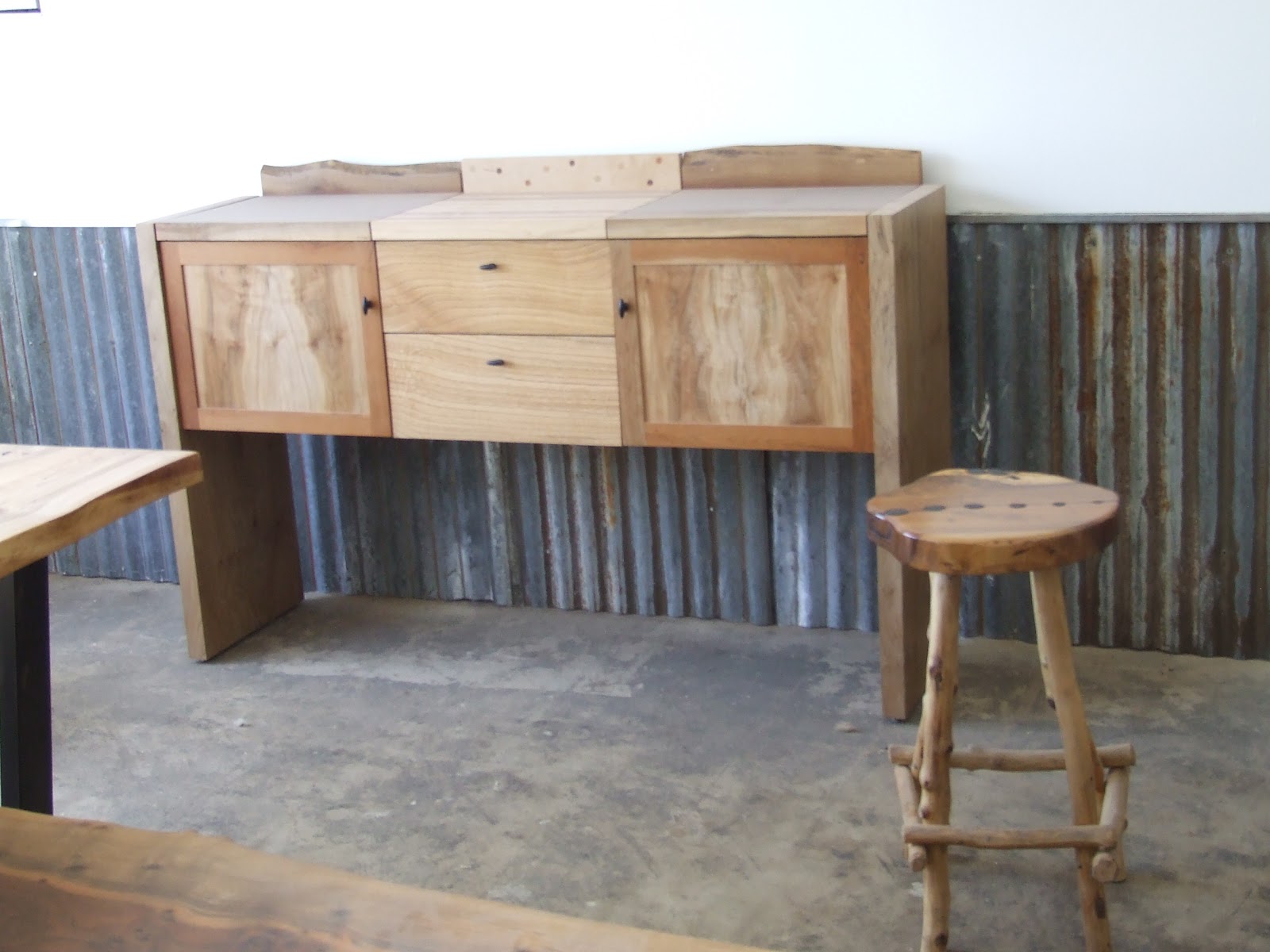
To this... everything is made from reclaimed urban lumber

New Approaches Mean New Opportunities
By Jack Petree
Groundbreaking work by David MacFarlane of Michigan State University’s Department of Forestry should cause those interested in the shape of the nation’s future forest products industry to sit up and take notice.
Billions of Board Feet
Recent work by Dr. MacFarlane indicates the U.S. urban forests are capable of producing annually about 3.8 billion board feet of wood suitable for processing into building products on a sustained basis through efficient removal and processing of dead and dying trees. On an annual basis, MacFarlane calculates, that is the board foot equivalent of the material required to build about 285,000 homes. All that from a resource that all too often has been considered waste to be disposed of in landfills.
In recent years, MacFarlane and other research professionals have participated in a number of efforts aimed at building awareness of, and making better use of, the resource represented by urban forests. The efforts have resulted in a fledgling urban forest products industry with considerable potential to become an important sector of the larger timber industry.
California Urban Forest Products Conference
A The 2011 California Urban Forest Products Conference (a gathering of industry participants in San Francisco) represented one more step in demonstrating the premise that urban forestry is a growth industry sector capable of one day changing the business landscape for harvesters, processors, lumber merchandisers, and end users of lumber and other wood products.
In the first half of the 20th Century, economist Joseph Schumpeter pointed out that while change created by entrepreneurial innovation creates economic growth, it can also lead to the destruction of older businesses, occupations, and approaches to business based on newly outmoded technologies or market conditions; firms not keeping up with the pace of change eventually perish.
Growth Industry
Few industries have seen as much change in recent decades as has the forest products industry. Some sectors of the industry were decimated by the winds of that change, but new industry sectors have seen considerable growth over those same decades. The California Urban Forest Products Conference opened a window offering a view of a forest products industry that may be on the edge of a significant growth spurt.
The ground breaking conference had loggers, academicians, sawmill owners, craftsmen and women, contractors, representatives from state and local governments, and avid members of green activist groups all rubbing shoulders as they explored the potential for working together to promote the vitality, diversity, and health of the urban forest across California. Sponsors of the event included the California Urban Forests Council, the California Department of Forestry and Fire Protection, and San Francisco’s Friends of the Urban Forest, a group dedicated to working with individuals and neighborhoods to plant and care for street trees and sidewalk gardens in San Francisco.
In the past, the concept of urban forestry has mostly been ignored by the traditional forest products industry. The lack of interest is partly based on a realistic appraisal of the difficulties inherent in relying on the urban forest for a dependable supply of fiber but lack of information about the potential the urban forest has in producing fiber to fill the nation’s need plays a part as well.
On the other hand, innovative entrepreneurs, like those attending the California Urban Forest Products Conference have been, in recent years, actively exploring the potential offered by 3.8 billion board feet of available material suitable for conversion to useful product.

Counter tops made from "waste" wood:  Woods Coffee
Building a Business
It is likely to be some years before a strong national urban forest products industry becomes a fully developed and established sector of the larger and more traditional forest products industry.
The California conference featured plenty of material spotlighting the difficulty firms will face in establishing and building a business based on urban forest products. However, based on information put forward at seminars, panels, and other presentations during the three days of the California Urban Forest Products Conference, there are strong indications that rapid growth and increasing stability for the urban forest industry of the future are not only possible, but likely.
While not everyone’s cup of tea, participants in today’s conventional forest products industry might want to take a close look at where the urban based segment of the industry is going as it builds into a significant supplier of lumbers, especially specialty lumbers, to serve the nation’s future needs.
Change is in the air.

Friday, July 6, 2012

LaVelle Winery and Pony Boy Gilbert - Here's How Real Environmentalism Works

This is what the old steel winery structure looks like after being reclad by Pony Boy Gilbert
The wine industry has a great trade publication called Vineyard And Winery Management.  Below is a story I wrote for the magazine a year or so ago.  The story is a great example of how environmentalism, stripped of all the politics and emotion, is really supposed to work.  If you're ever in Eugene, Oregon, visit LaVelle Vineyards.  They put the fine in fine wine and if you ever need something really special designed and built in a cost efficient and environmentally sensitive manner call Pony Boy.  He's amazing.
To the right, the new wood, sawn from logs that would usually be ground up into chips covers the old steel clad buildingvisible to the left.  Serious environmental benefits were achieved even as costs were reduced

When Doug LaVelle decided his winery and tasting room in Oregon’s Southern Willamette Valley needed an upgrade he worked with his builder and the owner of a local custom sawmill business to design a most unique approach to the project. The result, Doug comments, was entirely satisfactory in nearly every respect.   An old, steel clad “warehouse” looking structure housing the winery was transformed in appearance over the course of a few months into an elegant “Oregon Lodge” style attraction without significant disruption to winery operations and for a fraction the cost of more traditional approaches.  Equally important, Doug comments, he was able to act directly on the environmental ethic he espouses, achieving documentable environmental enhancements at almost every stage of the project. 
LaVelle Vineyards became the oldest bonded winery in the Southern Willamette Valley surrounding Eugene, Oregon when founder Doug Lavelle acquired, in 1994, the existing bonded winery license, 16 acres of vineyard, and a winery from the previous owners.   
Using knowledge gained over 30 years in the corporate world, Doug began to build the kind of wine business he'd always envisioned as a post-corporate career pursuit.  By 2008 LaVelle Vineyards’ physical property included not only the vineyard, the winery and the tasting room tucked into the quiet and secluded hills north of Eugene but also a terraced garden attraction with seasonal landscape displays and a wine bar and bistro known as the  “Club Room” at the historic 5th Street Public Market in downtown Eugene.
Doug says he was especially pleased in 2008 when his son Matthew, who’d been acting as operations manager for the firm while learning wine making from a master craftsman stepped up and formally became the LaVelle Vineyards winemaker.
What LaVelle did not have in 2008 was a destination winery and tasting room appropriate to the image Doug had created for the business. The winery structure, in its fourth decade of service, hadn’t aged beautifully.  By 2008, the industrial pole building’s siding had become sun bleached and parts of it were beginning to corrode.  The LaVelle’s decided it was time to upgrade their facilities to match the quality and image of their product. 
An early step was to contact one of Doug's contractor friends, Robert Stolle of Eugene's Ordell Construction for a brainstorming sessions. After some research, the men decided to investigate options other than tearing down the existing structure and constructing an entirely new building. 
Tearing the building down and starting over presented problems.  The winery would face extended downtime and would need to operate out of an alternate location for the duration.   "From an environmental standpoint," Doug recounts, "removing the existing structure and putting up a new one would have created a good deal of waste.  Recycling the old building was clearly a more attractive option.” 
“Possible alternatives investigated,” Doug continues,including removing the old steel from the building and replacing it with new metal siding that emulated a stucco look, or actually resurfacing the building with stucco.
 A fourth option presented itself with the introduction of Pony Boy Gilbert into the discussion. 
Pony Boy is proudly Native American and, Doug says with a smile, possesses a boundless enthusiasm, a dedication to practical environmentalism and a portable, thin-kerf sawmill. 
The solution Pony Boy put forward was to utilize his sawmill to mill some grand old incense cedar logs that would otherwise be chipped into pulp for a paper mill into boards usable in recladding the existing LaVelle winery.


Making lumber from logs otherwise destined to be underutilized as pulp chips
“The idea was immediately appealing,” Doug commented.  “I had been focused on creating a Tuscan look for the winery, an architectural theme that is commonly used in our business because it evokes an Old World ambiance.  But we don't live in Italy, we live in the Pacific Northwest, and I really preferred a solution that used local materials and fit comfortably into the Northwest landscape.  Pony's proposal got us thinking about an "Oregon Lodge" look constructed from cedar and stone."
Robert Stolle was familiar with Pony Boy’s expertise and thought the idea might have merit so, at Doug’s behest he took the concept and began to play with the possibilities, figuring out how accomplish the task of affixing lumber to the old building, and costing out the alternatives.
“We were surprised by the costs for the various options,” Doug said.  “Although I didn't keep all those numbers, using lumber milled by Long Tom Custom Sawmill (Pony Boy Gilbert’s company) was approximately 40% less than resurfacing with steel would have cost, and steel was roughly 30% less than the stucco option."
According to Robert Stolle, a 40% estimate for the lesser cost of lumber milled by Long Tom Sawmill vs. lumber purchased at a lumber yard is probably quite conservative, if difficult to quantify, because Pony Boy could mill lumber to exact specifications.  “Traditional supply channels typically provide only standard dimensions,” he comments.  “With Pony milling the wood on site we were able to get exactly the sizes we wanted including the thicker, rough cut boards the owner preferred.  We were able to obtain precisely milled specialty sizes without the extra cost of specialty milling, so both cost and waste were minimized.”
The decision was made to move ahead with the innovative solutions Robert Stolle, Doug LaVelle and Pony Boy had worked out between them and work began on upgrading the existing structure.  Ordell poured a new footing around the structure to support the weight of the wood.  The original metal building was left intact albeit attached to and surrounded by a new façade separated from the old building by an 8” space.  Logs were delivered and sawmilling began. 
The sawmill used by Long Tom Custom Sawmilling to mill logs to lumber is a portable, thin kerf sawmill (kerf is the thickness of the cut taken when a saw blade passes through a log).  First broadly marketed some twenty-five years ago by Wood-Mizer Products of Indianapolis, Indiana, the mills allow one and two person entrepreneurial firms to recover very high end lumber from trees that might otherwise be land-filled, under-utilized or simply left in the woods to rot and release the greenhouse gasses stored in them to the atmosphere.  
Today, estimates are some 20,000 plus businesses like Long Tom Custom Sawmilling provide service to builders, architects and individuals with access to those services in virtually every area of North America.
The LaVelle effort, according to Pony Boy Gilbert, is a case study in demonstrating that carefully considered environmental approaches to construction can also be profitable. 
“Doug LaVelle deserves huge credit for his commitment to environmental sensitivity,” Gilbert put forward.  “He put his money where his passion is by taking a chance on an unfamiliar approach based on my assurances this could not only result in the construction of a beautiful facility but also provide important environmental enhancements.”

According to Gilbert, “Those enhancements are real and documentable.”
“First,” Pony Boy said, “Wherever an old building can be effectively reused it should be.  It’s a terrible waste of resources, both natural and financial, to rip something apart just to replace it with something new when viable options are available.”
“Next,” Pony continued, the wood used was harvested within fifteen miles of where it was used so the emissions and other environmental impacts of transport were minimized.”

“We wanted to use Incense Cedar to demonstrate how environmental sensitivity can be practiced on a project like this,” Gilbert explained.  “ It’s a beautiful wood often piled up and sold for making chips as a byproduct of harvest.  The LaVelle building is, I believe, an outstanding example of how local and typically underutilized species can be put to their highest and best use.  Now, landowners throughout Central Oregon can visit the winery and see how resources on their own lands can be responsibly and sustainably utilized to optimize value and reduce waste.” 
Pony Boy points to the sawmill he used to mill lumber for the LaVelle Winery as providing  additional environmental enhancements.  The very thin cut taken by his Wood-Mizer means about 30% more lumber is recovered from a log than is typical in a conventional sawmill.  “That means the carbon contained in that additional thirty percent continued to be trapped in the wood for decades and it means thirty percent more trees are left standing and still scrubbing climate change gases from the atmosphere as a result of this mill,” he contended.  “A thinner blade also requires less energy to produce the lumber.  This is waste reduction, recycling and reuse at its best.”
“This has been a wonderful project for us,” Doug Lavelle said.  “We know that cedar will require more maintenance than steel but the opportunity to live our environmental ethic, achieve our goals regarding the aesthetics of the winery, and still be financial conservative is rewarding beyond what we thought possible when we conceived this project. How many times in business does a single solution represent the lowest cost, the highest quality, and the most environmentally responsible alternative?  Not many."